Palatine, IL & Surrounding Area24/7 Emergency Service — (847) 469-9619
Garage Door Opener Repair & Installation in Palatine, IL
When the remote clicks and nothing happens, the fault is usually a sensor, a gear or a logic board rather than the whole unit. We diagnose before we recommend, and we carry parts for every major brand on the truck.
A large share of the openers we are called out to replace do not need replacing. The three faults we see most are a misaligned safety sensor, a stripped gear and sprocket assembly, and a failed logic board, and all three are repairs rather than replacements on a unit that is otherwise sound. Sensors in particular get knocked out of line by a bicycle or a snow shovel and take minutes to reset.
So the first thing that happens on an opener call is a diagnosis. We test the sensors, the travel and force limits, the gear train, the board and the remote pairing before anybody starts quoting new equipment. If the repair is sensible we do the repair. If the unit is twenty years old and the board is discontinued, we will say so plainly rather than fitting a part that buys you six months.
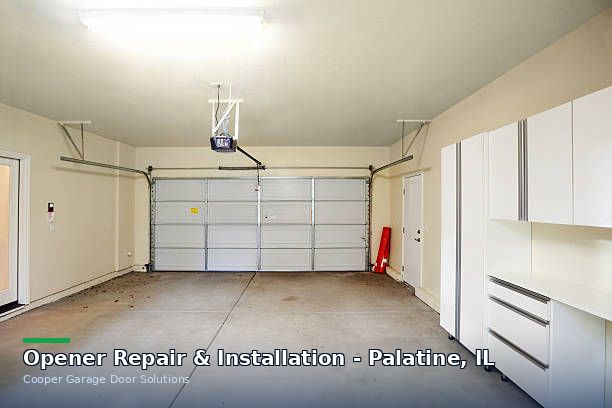
Opener Repair & Installation carried out across Palatine and the northwest suburbs.
Chain, Belt and Screw Drive
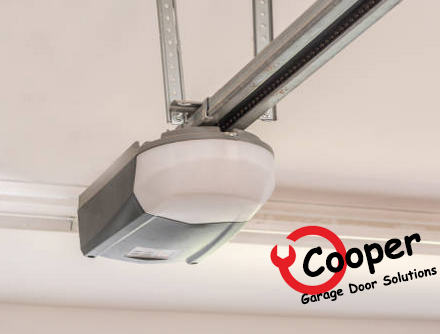
Chain drive is the workhorse. It is the least expensive to buy and repair, it tolerates cold garages well and it is loud, which matters only if there is a bedroom over the garage. Belt drive uses a reinforced rubber belt instead, runs quietly enough that you can open the door at five in the morning without waking the house, and costs more. Screw drive units run a threaded steel rod and sit between the two on noise, with fewer moving parts and a real dislike of neglect in an unheated garage.
Wall-mounted jackshaft openers are the fourth option and the answer to two specific problems. They mount beside the door rather than on the ceiling, so they work where a low ceiling, a car lift or exposed ductwork rules out a rail. They also free up the ceiling entirely if you want overhead storage.
What a New Installation Includes
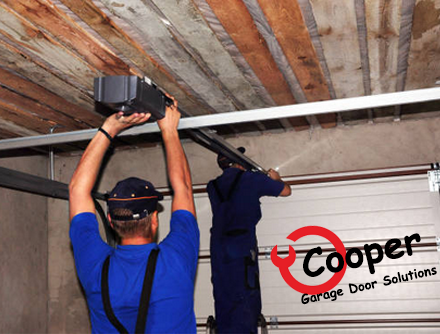
A new opener from us is fitted with the rail properly supported, the header bracket lagged into solid framing rather than drywall, the safety sensors set at six inches or lower and aligned, and the travel and force limits dialled in against the actual door. We then run the safety reverse test with a solid object on the floor, and we do it in front of you so you know it has been done.
Modern units come with rolling code security that changes the pairing after every use, battery backup that keeps the door working through a power cut, and smartphone control so you can check from work whether the door is shut. In Illinois, battery backup is worth having on its own merits given how often summer storms take the power out around here.
Every job is quoted before the work starts.
Openers We Did Not Sell You
We will fit a unit you bought yourself. Plenty of customers pick something up on sale and want it installed properly, and that is fine. The one thing we make clear up front is that a customer supplied opener carries the manufacturer warranty only, so a board that is dead out of the box is a conversation with the retailer rather than with us. Units we supply carry our warranty as well as the maker's.
One warning worth repeating. If you are on your second opener in eight years, the opener is almost certainly not the problem. A door with worn springs, dragging rollers or a bent track is a door that is slowly destroying every motor you bolt to it. We will check the door before we sell you a third one.
Signs You Need This Service
The motor runs but the door does not move
The door closes a few inches then reverses on its own
The remote works from three feet away and nowhere else
Grinding or rattling from the motor housing
The wall button works but no remote does, or the reverse
Questions We Get Asked
1 My opener runs but the door does not move. What is wrong?›
Nine times out of ten the gear and sprocket assembly inside the motor housing has stripped, or the trolley has been left disconnected from the emergency release cord. Reattaching the trolley is free and takes a second. A stripped gear is a straightforward repair and much cheaper than a new opener.
2 How long should a garage door opener last?›
Ten to fifteen years is typical, and a well maintained unit on a balanced door often goes longer. What kills them early is being asked to lift a door with worn springs or dragging rollers, so the honest answer is that opener life is mostly a function of how well the door itself is looked after.
3 Why does my door reverse before it touches the ground?›
Either the safety sensors are misaligned or something is interrupting the beam, or the close force and travel limits are set wrong. Both are adjustments rather than parts. If it started after a cold snap, stiff rollers can also trigger the force limit as the door slows down near the floor.