Palatine, IL & Surrounding Area24/7 Emergency Service — (847) 469-9619
New Garage Door Installation in Palatine, IL
A garage door is usually a third of what the street sees when it looks at your house, and it is one of the very few improvements that returns most of its cost at resale. We measure, supply and fit across Palatine and the surrounding suburbs.
We are a repair company first and we would rather fix your door than sell you one. But there is a point where repair stops being good value. Several dented or rusted sections, a door that has been back on the repair list three or four times in two years, a discontinued model whose panels cannot be matched, or a heavy uninsulated slab from the seventies that has been fighting your opener for a decade are all cases where replacement is the honest answer.
The other reason people replace is appearance. A faded, chalking, dented door drags down a house that is otherwise in good order. If you are listing in the spring, this is one of very few jobs where the appraiser and the buyer both notice, and it photographs better than almost anything else you can spend the same money on.
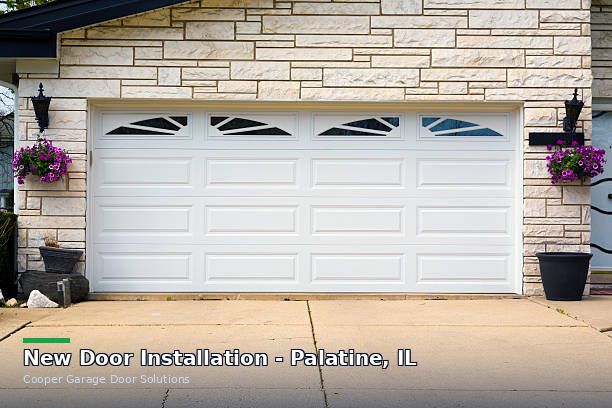
New Door Installation carried out across Palatine and the northwest suburbs.
Measuring Comes First
Nothing gets ordered until the opening has been measured properly. We take the width and height of the finished opening, then the headroom above it, the side room on both sides and the backroom running into the garage. Headroom decides the spring system and track type. Standard lift wants around twelve inches, low headroom kits get a door into ten or less, and high lift takes advantage of a tall ceiling to let the door sit higher, which matters if a car lift is going in.
We look at the framing while we are there. Rotted jambs, a sagging header or a floor that is out of level all have to be dealt with before a new door goes on, and finding that on measuring day is far better than finding it on installation day with a door sitting in the driveway.
Choosing the Door
Steel is what most houses around here end up with, in one, two or three layer construction. Single layer is a bare steel skin and the cheapest option. Two layer adds insulation behind it. Three layer sandwiches insulation between two steel skins and is markedly quieter, stiffer and better at holding its shape over twenty Illinois winters. Composite and faux wood overlays give you a carriage house look without the maintenance a real wood door demands.
Insulation is worth a moment of thought. If the garage is attached, shares a wall with a living space or has a room above it, an insulated door is not a luxury. R-values on garage doors are not comparable to wall insulation numbers, so we talk about them in terms of what you will actually notice: how cold the garage is in January, how loud the door is, and whether the room over it is usable.
Every job is quoted before the work starts.
Installation Day
A standard single door replacement is a half day. A double, or anything involving new tracks and a new opener, is usually most of a day. We remove and dispose of the old door and hardware, fit new tracks, rollers and hinges, size the springs to the weight of the door that is actually going on the wall, fit fresh weather seal at the bottom and up the jambs, and finish with a manual balance test.
The last thirty minutes matter as much as the rest. Travel limits and force settings on the opener get reset for the new door weight, the safety reverse is tested, and we walk you through the manual release and the maintenance schedule before we clear up. Old doors, brackets and packaging leave with us.
Signs You Need This Service
Several sections dented, rusted or split
The same door repaired three or four times in two years
A discontinued model where panels can no longer be matched
A heavy uninsulated slab fighting the opener every cycle
A tired, chalking door on a house going up for sale
Questions We Get Asked
1 How long does a new garage door installation take?›
A single door is generally a half day and a double door most of a working day. Add time if the tracks are being replaced, if the jambs need repair, or if a new opener is going in at the same time. We give you a window when we book rather than a vague morning or afternoon.
2 Do I need an insulated door?›
If the garage is attached to the house, shares a wall with a living room or has a bedroom above it, yes. You will notice it in January and you will notice how much quieter the door is. If it is a detached garage used for storage, an uninsulated door is a perfectly reasonable way to save money.
3 Can you match the new door to my house?›
That is the point of measuring in person. We bring the panel style, window layout, hardware and colour options to you and look at them against the actual house rather than a showroom wall, because a colour that works on a brick elevation can be wrong on siding.